Arizona has imported some peculiar neighbors: a bird whose American story runs through Central Park, a grass planted to feed cattle, and aquarium snails that turned a pet problem into a river problem.
Some of the state’s biggest headaches began as somebody’s good idea. Others slipped in unnoticed and found our gardens, buildings, and waterways surprisingly comfortable.
These 25 arrivals show how quickly a pretty plant, useful animal, or tiny hitchhiker can wear out its welcome.
Birds That Made Themselves at Home
1. European Starling
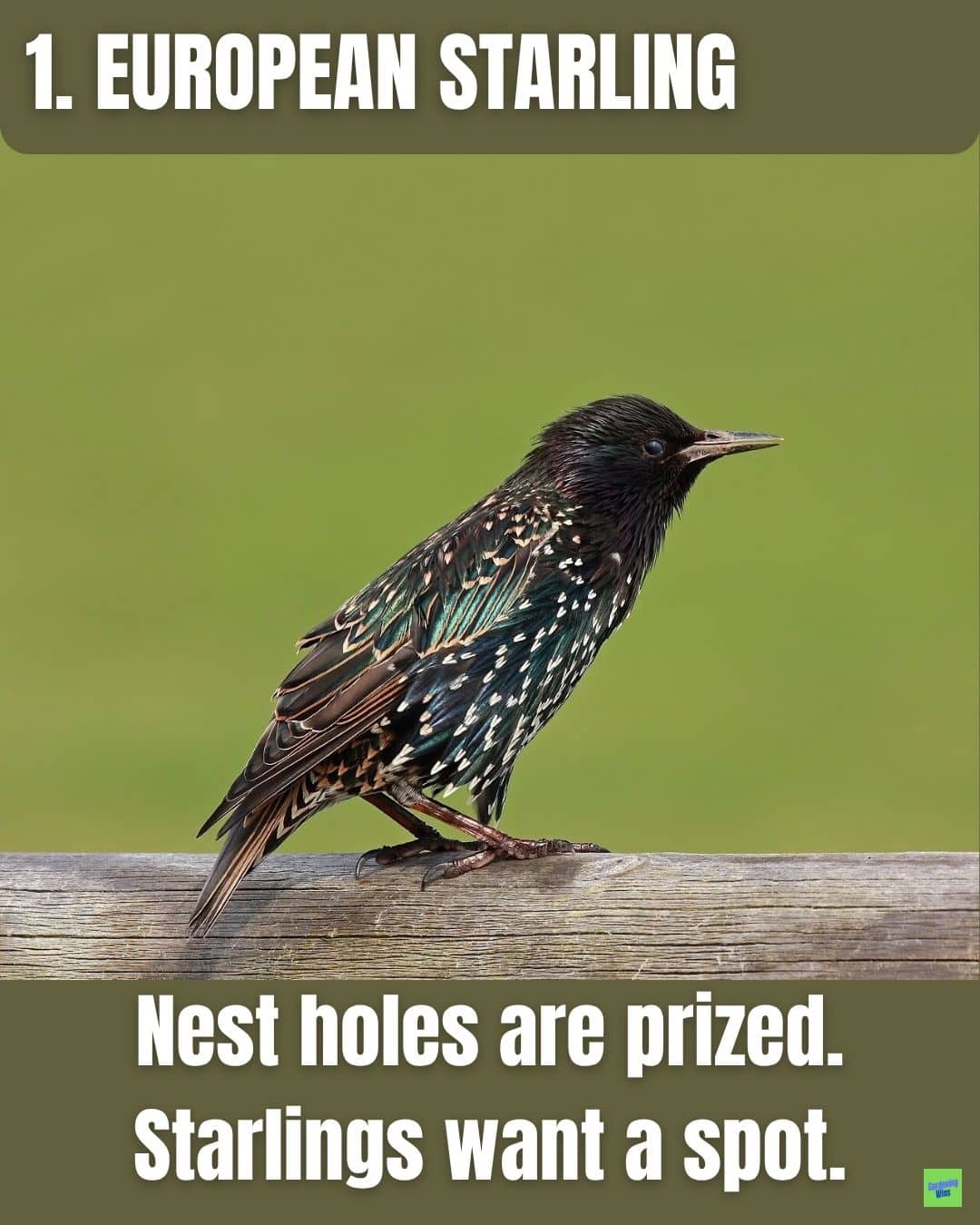
Sturnus vulgaris
A Gila woodpecker does the hard work of excavating a saguaro. A starling sees a move-in-ready home. Those shimmering feathers conceal a formidable competitor.
Its American success followed nineteenth-century introductions, including several releases in New York’s Central Park. The population spread across the continent, eventually reaching Arizona.
Those nest holes are valuable real estate. Competition can put native birds at a disadvantage, while flocks help themselves to agricultural food.
A spectacular flock looks different when you are the farmer supplying lunch.
2. House Sparrow

Passer domesticus
The little brown crumb inspector outside a restaurant has a surprisingly long history. House sparrows were introduced in Brooklyn in 1851; later releases in San Francisco and Salt Lake City helped them spread through the West.
We supplied nearly everything they needed: grain, buildings, sheltered nooks, and eventually an astonishing number of parking lots. The “house” in their name is well earned.
The friction starts at nesting time. House sparrows aggressively defend cavities and can evict other birds. A nest box intended as a favor to native wildlife may attract an altogether different tenant.
Nest-box tenants do not always match the landlord’s intentions.
3. Rock Pigeon

Columba livia
Before pigeons were parking-lot regulars, we employed them. People raised them for food, messages, racing, and companionship, bringing rock pigeons from Europe to North America centuries ago. Today’s free-living flocks carry that domestic history into Arizona cities.
A building ledge is a convincing substitute for a cliff. Add spilled grain or discarded food, and a pigeon has little reason to move along.
One bird on a roof is hardly a crisis. An established roost is a different proposition: droppings and nesting debris accumulate, fouling surfaces and clogging gutters. Solar panels can become an especially inconvenient address.
Its domestic talents have become a property-maintenance headache.
4. Eurasian Collared-Dove

Streptopelia decaocto
This dove took the scenic route to Arizona. Birds released in the Bahamas in the 1970s reached Florida, where breeding was documented in 1982, then spread remarkably quickly across North America.
Now that pale dove with the black neck collar can look as ordinary as a mailbox. Developed neighborhoods and plentiful seed have helped the newcomer settle in.
A well-stocked feeder can attract a pushy regular. Collared-doves can dominate other birds around food, although that does not establish that they are causing native dove populations to decline.
For now, the everyday nuisance is a competitive neighbor with a remarkable talent for moving in.
Small Insects, Expensive Problems
5. Bagrada Bug

Bagrada hilaris
Bagrada bugs look almost too neatly decorated to be trouble. The black, orange, and white markings belong to a stink bug with a particular enthusiasm for plants in the mustard family—including the broccoli and cabbage you were planning to eat.
Native to parts of Africa and Asia, the pest was found in California in 2008 and officially identified in Yuma in September 2009. It subsequently turned up in several more Arizona counties; its exact original ride into the region is less clear.

It drinks plant juices through piercing mouthparts. Tender seedlings pay heavily for that meal, with damaged growing points and stunted growth.
The smart markings are little consolation for a spoiled vegetable bed.
6. Yellow Fever Mosquito

Aedes aegypti
A desert seems like a poor place to start a mosquito dynasty. Then people add flowerpot saucers, buckets, irrigation, and little pockets of standing water. Suddenly the neighborhood looks much more promising.
Originally from Africa, Aedes aegypti spread widely with human activity. Arizona’s history includes early twentieth-century records, a long gap in detections, and a Tucson rediscovery in 1994. New introduction or overlooked population? Researchers were uncertain.

Its eggs can survive drying, making water-holding containers stubborn nurseries. The breeding site may be much smaller than the pond you are blaming.
Besides being a biting nuisance, this species can transmit viruses including dengue. Its “yellow fever” name describes a capability, not evidence of a local yellow-fever outbreak.
7. Asian Citrus Psyllid

Diaphorina citri
You could miss an Asian citrus psyllid while admiring an entire orange tree. Only a few millimeters long, it feeds with its rear end raised like a tiny car on a jack.
This Asian arrival was first detected in Arizona at San Luis in 2009 and spread through the state’s citrus-growing areas. Adults fly between host plants; moving infested plants can give them a much longer lift.
Feeding damages tender growth, but the bigger problem is the bacterium it can carry. Citrus greening disease can leave fruit bitter or misshapen and eventually kill the tree.
Not every psyllid carries the disease, but even backyard citrus owners have reason to pay attention.
8. Africanized Honeybees

Apis mellifera hybrids
The backstory begins with an attempt to improve honey production in Brazil. African honeybees brought into a breeding program escaped in 1957, mixed with European honeybees, and their descendants spread north. They were recorded in Arizona in 1993.
That history has become part of the state’s feral honeybee population. You cannot reliably identify Africanized ancestry by looking at a bee on a flower, and a busy forager is usually interested in its meal.
The serious problem is defending a colony. Disturbance—including nearby mowing or other power equipment—can trigger a large response and multiple stings.
An occupied cavity beside the shed deserves more caution than a bee visiting a blossom.
From Houseguests to Desert Icons
9. Roof Rat

Rattus rattus
Phoenix roof rats found a version of desert living with excellent amenities: mature citrus, palms, irrigation, and food around houses.
Documented in Phoenix in 2001, these Old World rodents likely arrived with freight or shipments of food, feed, or equipment. Their local success owes plenty to the comfortable habitat we built afterward.
They climb readily, and an attic offers shelter conveniently close to the next meal. Gnawing, contaminated food, and nighttime activity turn that arrangement into a homeowner’s problem.
A fruit tree can feed more than the family that planted it. Fallen citrus and shelter help rats settle in.
10. House Mouse

Mus musculus
The house mouse is an old hand at moving in with people. Accidental arrivals at North American seaports were followed by a continent-wide expansion alongside our buildings and food stores. Arizona homes and outbuildings are part of that long success story.
It does not require a dramatic hole in the wall. An opening around a quarter-inch wide can be enough. Once inside, cardboard, fabric, and insulation offer nesting material close to the pantry.
The damage includes gnawed packaging and food contaminated by droppings. A cereal box is both something to get through and something worth getting through.
Native mice are different species; this one specializes in living alongside us.
11. Feral Burros

Equus asinus
A burro beside an Arizona road looks like it belongs on a postcard. Its family history belongs to people: explorers brought donkeys to the Americas, and nineteenth-century miners added more. Escaped and released animals established free-roaming herds.
Their desert ancestry helped them cope with the Southwest. They browse shrubs and trees, eat seasonal growth, and take advantage of bean crops from mesquite and other desert trees.
The difficulty is population pressure on limited habitat. Too many large mouths can strain vegetation and resources shared with native wildlife. Roadside feeding also encourages dangerous gatherings near traffic.
They remain protected animals with a complicated place in Western history. Enjoy the long ears from a distance.
12. American Bullfrog

Lithobates catesbeianus
That deep pond-side call sounds like an old American summer. In Arizona, it belongs to a transplant from the eastern part of the continent—and a predator with a remarkably broad menu.
Bullfrogs were brought to Arizona for sport hunting in the early 1900s. Around Tucson, golf-course water features and backyard ponds have helped provide places to stay.
A bullfrog can eat other frogs, small fish, and even small reptiles. Native leopard frogs face both a hungry neighbor and another competitor in scarce aquatic habitat.
A decorative pond can supply invaders to the wild desert around it.
13. Red-eared Slider

Trachemys scripta elegans
A tiny turtle is an easy pet to buy and a much bigger commitment than it first appears. Released red-eared sliders have turned that mismatch into a wildlife problem: an unwanted aquarium resident becomes an uninvited pond resident.
At Montezuma Well, sliders introduced in the late 1960s or early 1970s competed with native Sonoran mud turtles for food, basking spots, and other resources. Native turtles declined.
There is a good ending to this particular chapter. A removal effort from 2007 through 2011 took the sliders out of the Well and placed them in a permanent captive home.
Elsewhere in Arizona, “setting it free” still creates years of work.
Plants That Escaped the Plan
14. Stinknet

Oncosiphon pilulifer
Stinknet is very good at looking cheerful from a moving car. A sweep of yellow buttons appears across an open patch, and for a moment it resembles the wildflower show everyone hoped the rain would bring.
The South African plant’s first Arizona herbarium collection dates to 1997. Its original route into the state is unknown; tiny seeds now have plenty of opportunities to travel with vehicles, water, animals, and disturbed soil.
The spring display comes with a summer bill. Dense patches crowd native annuals, then dry into fuel that helps fire cross the open spaces between desert plants.
Crushed foliage has an odor often compared to turpentine. The name is a clue.
15. Buffelgrass

Cenchrus ciliaris
Buffelgrass arrived with a job offer. Introduced for cattle forage in the 1930s, it promised useful grass in a dry landscape. The trouble was what happened when a productive pasture plant moved beyond the pasture.
Its seeds spread, and dense clumps established on southern Arizona roadsides and desert slopes. After rain it looks green and promising; later, that growth dries.

Buffelgrass connects the gaps that normally help limit desert fire. Flames can travel through the grass into saguaro habitat, where many native plants are poorly equipped to survive.
The grass is adapted to fire and can recover after the damage. Over time, that advantage threatens to trade a varied desert landscape for more grass—and more opportunities to burn.
16. Fountain Grass

Cenchrus setaceus
Fountain grass did not sneak into Tucson hidden in a crate. People planted it because it looked good. It was being cultivated there by 1940, and records place escaped plants in the Santa Catalina Mountains by 1946.
The arching leaves and fluffy flower heads still explain the appeal. Seeds explain the escape: wind, water, animals, and people can carry them beyond the landscaped border.
In washes and on slopes, dense stands displace native vegetation and add fuel for hot fires. They can also interfere with water moving through a wash.
The yard was never a reliable boundary. An attractive garden plant can become everyone’s problem.
17. Sahara Mustard

Brassica tournefortii
A possible early passenger in California’s date industry became a spoiler for desert wildflowers. Sahara mustard may have arrived with imported North African palms; that suspected route is not a proven shipping record.
The plant subsequently spread across the Southwest. A specimen collected near Tucson in 1978 documents its presence there well before it became an abundant sight.
Its advantage is timing. Sahara mustard starts early in the cool season, spreads broad leaves, and can build a canopy over smaller native annuals. Native wildflowers struggle underneath.
A green desert is not always a healthy wildflower season. A thick mustard patch can deliver plenty of vegetation while producing a much poorer show of native blooms.
18. Saltcedar

Tamarix ramosissima / T. chinensis and hybrids
Saltcedar has the résumé of a useful landscape tree: ornamental planting, windbreaks, and erosion control all helped spread tamarisks in the West. Wind and water then carried their seeds beyond the places people intended them to grow.
Arizona river corridors offered room for dense stands that compete with native vegetation and change habitat and fire conditions. In 2006, a flood brought thousands of seedlings into Saguaro National Park’s Rincon Creek drainage.
Then comes the complication: endangered southwestern willow flycatchers sometimes nest in tamarisk. A tree can be an ecological problem and still hold a bird’s home.
Restoring a riverbank takes planning: removing nesting cover creates its own problem.
19. Giant Reed

Arundo donax
That tall wall of “bamboo” beside the water may be giant reed, a grass people spread for ornament and erosion control. It reached California in the early nineteenth century and was widely planted in warmer parts of the country.
In Arizona, waterways and wet ground give it places to form dense stands. The trick is that it does not need a packet of seed to start another patch.

Pieces of stem and underground rhizome can grow into new plants. Floods can move those pieces downstream, turning broken vegetation into fresh colonies.
The resulting thickets crowd native plants, obstruct flow, and build up dry fuel. Careless cutting can leave plenty of material for a comeback.
Unwelcome Company in the Water
20. Quagga Mussel

Dreissena rostriformis bugensis
A fishing boat can travel hundreds of miles on a trailer. So can whatever is attached to it—or floating in the water left inside.
Quagga mussels, native to the Dnieper River drainage, were detected in Lake Mead in 2007. Human movement of watercraft helps these mussels cross distances they could never manage alone. Adults cling to hard surfaces; microscopic larvae travel in retained water.
Once established, colonies can clog water intakes and equipment. Their filtering also removes tiny organisms from the water, changing food available to other aquatic life.
A hull that looks clean does not tell the whole story. The smallest passengers may be riding inside.
21. New Zealand Mudsnail

Potamopyrgus antipodarum
For a New Zealand mudsnail, a wet boot can be long-distance transportation. Small enough to overlook, these snails can move on fishing gear and other equipment used in different waters.
Arizona first detected them at Lees Ferry in 2002. They subsequently spread downstream through the Grand Canyon, and records now include waterways such as Oak Creek and the lower Salt River. The first carrier remains unidentified.
The startling part is their reproductive shortcut: a single snail can start a population without finding a mate. Dense populations compete with native invertebrates for food.
A nearly invisible passenger can become a very visible problem.
22. Red Swamp Crayfish

Procambarus clarkii
Here is a fact that surprises people who grew up turning over creek rocks: Arizona has no native crayfish. Those miniature lobsters are newcomers, including the red swamp crayfish documented in several Arizona drainages.
People have moved this species far beyond its southeastern home for food, aquariums, bait, and classroom use. Releases and escapes are familiar pathways nationally, though the history of every Arizona population is not neatly recorded.
Once loose, it eats aquatic plants and animals, rearranging both the menu and the habitat in the shallows. A creature that seems perfectly ordinary in one region can be disruptive in another.
An interesting captive animal still needs a home that stays contained.
23. Green Sunfish

Lepomis cyanellus
A green sunfish is small enough to seem like harmless pond scenery. Its relatively large mouth offers a better clue to what it does for a living: eat things smaller than itself.
Green sunfish have traveled as accidental passengers in stockings of bluegill and other fish. An inadvertent introduction is suspected at Lake Mead in 1937; their presence in Arizona predates that record.
Now established in Lake Powell, some survive passage through Glen Canyon Dam. Warm backwaters downstream offer breeding habitat close to vulnerable native fish.
A small warm pond can become a surprisingly important trouble spot. Managers remove green sunfish from off-channel habitat below the dam to limit their spread.
24. Invasive Apple Snails

Pomacea spp.
Bubblegum-pink blobs above the waterline look like something a child stuck to a reed. They are apple-snail eggs, and their Arizona backstory is less colorful: unwanted aquarium pets dumped into the Verde River around 2009.
The introduced snails spread into the lower Salt River, Valley canals, and urban lakes. Females can produce thousands of young annually, putting native snails up against a prolific competitor.
A discarded pet has become a recurring river-cleanup job. During one June 2026 outing, biologists and volunteers removed nearly 300 snails and destroyed more than 8,000 egg masses along a stretch of the lower Salt.
Emptying an aquarium can leave a remarkable amount of work downstream.
25. Common Carp

Cyprinus carpio
Common carp received an official welcome. In 1877, the U.S. Fish Commission imported them from Germany and began distributing them as food fish. Arizona records extend back to the nineteenth century. This invasion had enthusiastic assistance.
Stocking, escapes, and further movement helped carp become familiar residents of American waterways. They were already in the Colorado River system before Lake Powell filled.
Their habit of feeding along the bottom can stir sediment and disturb aquatic vegetation. Where carp become abundant, the shallows can get cloudier and plants can suffer. The scale of the effect depends on the waterbody and the population.
A fish once promoted as a useful addition became a problem for later generations to manage.
The Part We Keep Playing
The recurring character in these stories is us: the gardener, pet owner, farmer, traveler, and well-meaning person with a bucket. We supply rides and comfortable places to land. Keeping aquarium pets out of rivers, cleaning wet gear, and choosing plants that stay where they belong may sound modest. So did many of the decisions that started these stories.
Photo Credits
Identification cards are cropped and include added titles, impact text, and the Gardening Wins logo. Adaptations of ShareAlike photographs are available under CC BY-SA 4.0; original licenses are linked below. The Gardening Wins name and logo remain trademarks. Supporting detail photos are unaltered.
- 1. European Starling: Charles J. Sharp; source photograph; CC BY-SA 4.0.
- 2. House Sparrow: Hobbyfotowiki; source photograph; CC0.
- 3. Rock Pigeon: Dori; source photograph; CC BY-SA 3.0 us.
- 4. Eurasian Collared-Dove: Charles J. Sharp; source photograph; CC BY-SA 4.0.
- 5. Bagrada Bug: Danish971; source photograph; CC BY-SA 4.0.
- 5. Bagrada Bug detail: Downtowngal; source photograph; Public domain.
- 6. Yellow Fever Mosquito: James Gathany / CDC, PHIL 9258; source photograph; Public domain.
- 6. Yellow Fever Mosquito detail: CDC; source photograph; Public domain.
- 7. Asian Citrus Psyllid: Jeffrey W. Lotz / Florida Department of Agriculture; source photograph; Public domain.
- 8. Africanized Honeybees: Ktr101; source photograph; CC BY-SA 4.0.
- 9. Roof Rat: Alex O'Neal; source photograph; CC BY-SA 2.0.
- 10. House Mouse: DiegoDiegoDiego555; source photograph; CC BY-SA 4.0.
- 11. Feral Burros: Joshua Noble; source photograph; CC BY-SA 2.0.
- 12. American Bullfrog: Cephas; source photograph; CC BY-SA 3.0.
- 13. Red-eared Slider: Diego Delso; source photograph; CC BY-SA 3.0.
- 14. Stinknet: Krzysztof Ziarnek, Kenraiz; source photograph; CC BY-SA 4.0.
- 15. Buffelgrass: Krzysztof Ziarnek, Kenraiz; source photograph; CC BY-SA 4.0.
- 15. Buffelgrass detail: National Park Service; source photograph; Public domain.
- 16. Fountain Grass: Forest & Kim Starr; source photograph; CC BY 3.0.
- 17. Sahara Mustard: Krzysztof Ziarnek, Kenraiz; source photograph; CC BY-SA 4.0.
- 18. Saltcedar: Jerzy Opioła; source photograph; CC BY-SA 3.0.
- 19. Giant Reed: Krzysztof Ziarnek, Kenraiz; source photograph; CC BY-SA 4.0.
- 19. Giant Reed detail: Bouba at French Wikipedia; source photograph; CC BY-SA 3.0.
- 20. Quagga Mussel: USGS; source photograph; Public domain.
- 21. New Zealand Mudsnail: H. Zell; source photograph; CC BY-SA 3.0.
- 22. Red Swamp Crayfish: Eugene Zelenko; source photograph; CC BY-SA 4.0.
- 23. Green Sunfish: Sam Stukel / U.S. Fish and Wildlife Service; source photograph; Public domain.
- 24. Invasive Apple Snails: Dr. Raju Kasambe; source photograph; CC BY-SA 3.0.
- 25. Common Carp: Motokoka; source photograph; CC BY-SA 4.0.
_Leek_Wootton.jpg)
,_Amrum.jpg)

_Rajasthan.jpg)


.jpg)

.jpg)

,_Jard%C3%ADn_Bot%C3%A1nico,_M%C3%BAnich,_Alemania_2012-04-21,_DD_03.JPG)


.jpg)
.JPG)
