A hummingbird feeder can become an ant highway or a wasp hangout surprisingly fast. The safest quick fix is wonderfully simple: place a plain-water ant moat between the hanger and feeder, then keep the feeder clean and drip-free.
It blocks crawling insects without coating the pole in grease or spraying chemicals near birds. A few small setup changes also make nectar harder for bees and wasps to reach while keeping every feeding port easy for hummingbirds to use.
The Simple Trick: Hang a Plain-Water Ant Moat Above the Feeder
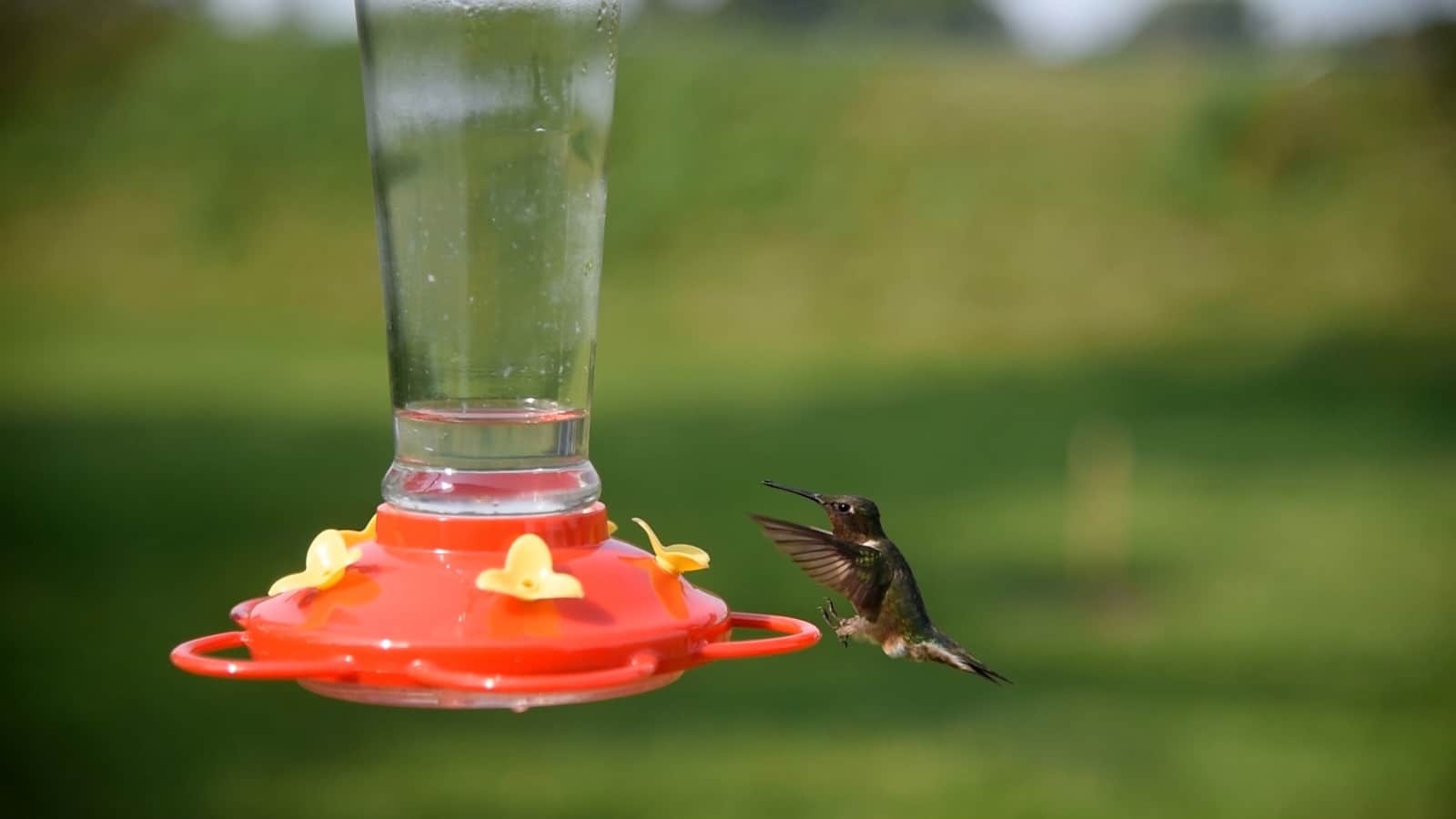
Ants do not magically appear inside a feeder. They march down the hook, wire, chain, or pole that connects the sugar water to its support. That predictable route is exactly what makes an ant moat so effective.
An ant moat is a small cup that sits in the hanging path above the feeder. Fill it with plain water, and a crawling ant meets a tiny “drawbridge” that is up before it reaches the nectar.
The order matters: hanger first, ant moat second, feeder last. A moat hanging beside the reservoir—or below it—does not interrupt the ants’ route. Some saucer-style feeders have a moat molded into the center of the lid; bottle feeders can use a separate cup with a hook above and below.
Use only water. Do not add cooking oil, detergent, insecticide, or anything sticky. A hummingbird that brushes against an oily or gummy surface can get the substance on its feathers, where it may interfere with insulation and flight.
The cup is small, so it can dry out quickly. Top it off whenever you check the nectar, and empty, rinse, and refill it every day or two. That keeps the barrier working while preventing a neglected cup from becoming slimy or holding water long enough for mosquitoes to develop.
The Cornell Lab of Ornithology recommends water-filled moats for this job. It is a wonderfully low-tech fix: no fumes, no poison, and no residue near a bird’s food.
Beat Bees and Wasps by Stopping the Drips

An ant moat only stops insects that crawl. Bees and wasps can fly straight to a feeding port, so their biggest invitation is usually not the red plastic—it is nectar on the outside of the feeder.
Inverted bottle feeders are the usual drippers. Sun warms the air and nectar inside the bottle, pressure changes, and a little sugar water may work its way out. Wind, a loose base, worn seals, or a reservoir filled too high can make the leak worse.
Move the feeder into open shade, tighten every part, and inspect the base for hairline cracks or warped pieces. Fill only as much as the birds can finish before the next cleaning. A smaller batch means less pressure, less waste, and less sticky nectar available to insects.
Wipe the bottle, ports, perch, and hanger whenever you refill. If nectar drips onto a deck rail or patio, wash that spot too. Bees have excellent location memory; a sugar-scented landing pad can keep drawing them back even after the feeder itself looks clean.
If the feeder keeps leaking after it is cleaned and correctly assembled, replace the damaged part or retire it. A charming feeder that cannot hold nectar inside is doing more for the yellow jackets than the hummingbirds.
Make the Nectar Easy for Birds—and Awkward for Insects

A saucer feeder holds the nectar below its ports instead of above them. Gravity helps keep the liquid where it belongs, and a bee or wasp with a short tongue may be unable to reach the reservoir. This design is often less leaky and easier to scrub than an inverted bottle.
Bee guards can help too, but only when they fit snugly and remain undamaged. Do not enlarge the openings, and replace guards that have split or fallen inward. A hummingbird’s long bill and tongue can reach through a properly sized port; many insects cannot.
The recipe should stay simple: one part plain white granulated sugar to four parts water. Skip red dye, honey, brown sugar, raw sugar, molasses, and artificial sweeteners. The feeder supplies all the color a hummingbird needs to notice it.
Freshness matters to pest control as much as feeder design. Fermenting nectar smells stronger, gets sticky, and can attract more insects. Change it every two to three days in mild weather and daily during very hot spells. If it turns cloudy, develops strings or specks, or smells sour, discard it immediately.
Do not top off yesterday’s nectar. Empty the feeder, take it apart, scrub the reservoir and ports with a dedicated brush, and rinse every surface thoroughly before adding a fresh batch. The Cornell Lab’s feeder guidance favors easy-to-clean saucer feeders, while Audubon’s nectar recipe uses the same 4-to-1 ratio.
Skip Oils and Pesticides—Use a Bird-Safe Reset Instead

Petroleum jelly, axle grease, cooking oil, sticky tape, and tree-band products may look like clever ant barriers. Around birds, they are bad bets. Anything that can transfer to a hummingbird’s feathers does not belong on the hanger, pole, or feeder.
Sprays and powders are risky for a different reason. They can contaminate feeding surfaces, harm pollinators, and remove the tiny insects hummingbirds eat for protein and fat. Nectar is fuel, but it is not a complete diet; hummingbirds also snatch gnats, aphids, spiders, and other small arthropods.
If flying insects have taken over, wash the feeder and the surface beneath it, fix every leak, and move the feeder a short distance. Hummingbirds patrol a wider area and usually rediscover it quickly, while insects may spend time returning to the old location. A move is a reset, not a substitute for cleaning.
You can also spread the traffic by growing pesticide-free, regionally native flowers. Cardinal flower in the East and locally appropriate native salvias or penstemons in many other regions give hummingbirds another nectar source without concentrating every visitor at one plastic port.
Bees and wasps are valuable pollinators, so the goal is separation rather than extermination. A water moat for ants, a drip-free feeder for flying insects, and fresh nectar for the birds solve the problem without turning the feeding station into a chemical trap.
If you cannot keep the nectar fresh or the feeder clean, take it down until you can. An empty hook is safer than a pest-free feeder full of spoiled sugar water.
Image Attributions
The Simple Trick: Hang a Plain-Water Ant Moat Above the Feeder
- “Ruby-throated hummingbird (50274767441)” by Courtney Celley/U.S. Fish and Wildlife Service Midwest Region, public domain. Resized.
Beat Bees and Wasps by Stopping the Drips
- “Hummingbird Feeder (27721019784)” by Dorian Wallender, licensed under CC BY-SA 2.0. Resized.
Make the Nectar Easy for Birds—and Awkward for Insects
- “Ruby-throated hummingbird (50037694183)” by Courtney Celley/U.S. Fish and Wildlife Service Midwest Region, public domain. Resized.
Skip Oils and Pesticides—Use a Bird-Safe Reset Instead
- “Ruby-throated hummingbird on cardinal flower (5871175853)” by Bill Buchanan/U.S. Fish and Wildlife Service Headquarters, licensed under CC BY 2.0. Resized.
Featured Image
- “A Simple Feeder Trick That Helps Keep Pests Away From Hummingbirds” — image supplied by JPE Media and used with permission.