The plants most likely to cause trouble rarely look dangerous at the garden center. They come in tidy pots with glossy tags promising fast growth, easy care, colorful flowers, or year-round coverage.
But those selling points can become warning signs once the plant escapes its bed, spreads through berries or runners, and crowds out nearby growth.
Availability does not mean a plant is safe everywhere, so always check the scientific name against your state’s invasive-plant list.
Four questions to ask before putting it in your cart

- Is the species listed as invasive, prohibited, restricted, or a plant of concern in my state?
- Does it spread through berries, windblown seeds, underground runners, or stems that root wherever they touch soil?
- Is the exact cultivar truly sterile, or is it merely advertised as producing fewer seeds?
- Is there a regionally native plant that provides the same flowers, fall color, screening, or ground coverage?
1. Japanese Barberry (Berberis thunbergii)

Japanese barberry checks several popular landscaping boxes. It tolerates poor soil, handles pruning, resists deer, and comes in burgundy, red, yellow, and green-leaved varieties.
Its thorny branches also make it attractive for low defensive hedges.
The trouble may not appear directly beneath the parent shrub. Birds and small mammals eat its red berries and deposit the seeds elsewhere, including woodland understories.
Its arching branches can also root after touching the ground, allowing one shrub to slowly become a dense mass.

Established colonies crowd out native woodland plants and create thick, humid cover close to the ground.
Researchers and extension specialists have also warned that this sheltered habitat can support higher numbers of black-legged ticks.
Better choices: Look for Virginia sweetspire, fragrant sumac, inkberry holly, or New Jersey tea where those plants are native and suited to your conditions. They can provide structure and seasonal interest without introducing another seed source into nearby woods.
2. Burning Bush (Euonymus alatus)

Burning bush has one unforgettable trick: its foliage can turn almost fluorescent red in fall.
It also tolerates sun, shade, drought, and heavy pruning. That combination explains why landscapers planted it around homes, offices, and parking lots for decades.
Its small fruits are far less dramatic, but they are responsible for much of the problem.
Birds carry the seeds beyond the landscaped property. Seedlings can then establish along forest edges, roadsides, fields, and woodland interiors.
The shrub may also produce new stems from spreading roots.
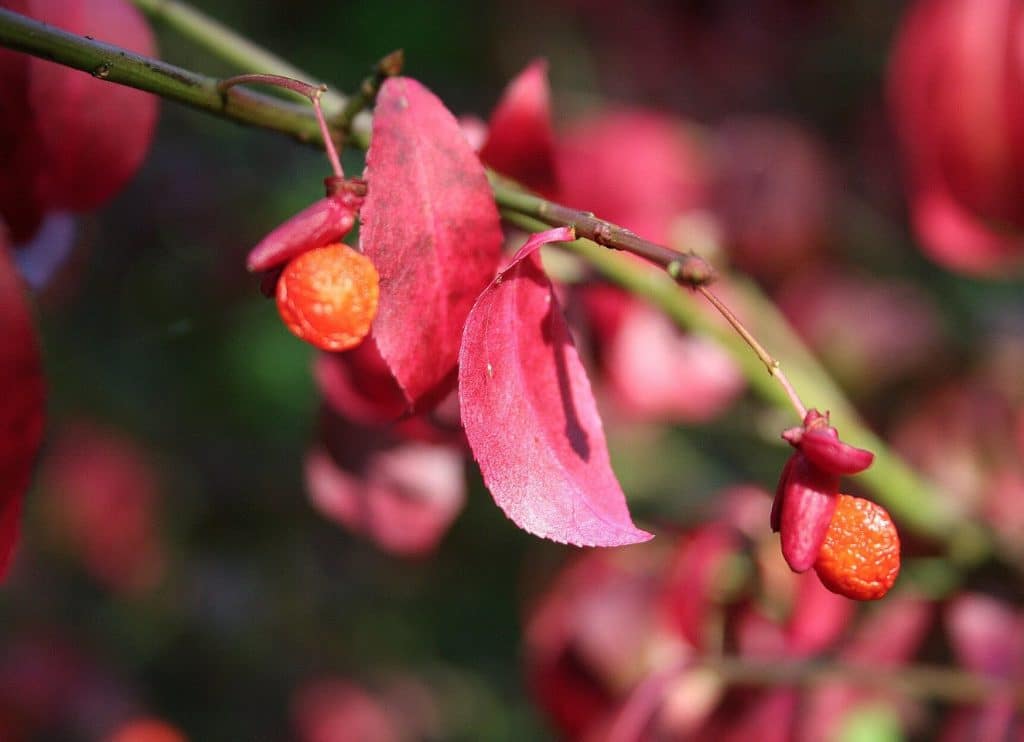
Wild seedlings often do not develop the same blazing color seen on a sunny, carefully maintained hedge.
That makes them easy to overlook while they build dense thickets beneath trees and compete with native shrubs and wildflowers.
Better choices: Virginia sweetspire offers striking fall color and fragrant flowers. Fragrant sumac, oakleaf hydrangea, native blueberries, and several native viburnums can also put on an excellent autumn display. Match the species to your region before planting.
3. English Ivy (Hedera helix)

English ivy is sold as a nearly effortless solution for shade, bare soil, walls, fences, and slopes.
It stays green through winter in many climates and can cover an unattractive area faster than most conventional groundcovers.
That speed is exactly what makes it difficult to contain.
Stems creep across the soil and root as they travel. When they reach a tree, wall, or other rough surface, tiny aerial rootlets allow the vine to climb.
Mature vines eventually flower and produce berries that birds can carry into new areas.

On the ground, a heavy ivy mat can block light from low-growing native plants.
On trees, the added foliage catches wind, snow, and ice while hiding structural problems beneath the vines.
English ivy can also hold moisture against bark, masonry, and other surfaces.
Better choices: For shade, consider wild ginger, foamflower, native sedges, or woodland phlox suited to your area. When a climbing vine is needed, Virginia creeper or another regionally native vine may be a better fit, though vigorous native vines still require occasional management.
4. Callery or Bradford Pear (Pyrus calleryana)

Callery pears became suburban favorites because they grow quickly, bloom heavily in early spring, and tolerate difficult urban conditions.
They handle compacted soil, pollution, and heat surprisingly well.
“Bradford” is only one cultivar, although the name is often used for the entire species.
Early Bradford pears were widely promoted as unable to reproduce with themselves.
The problem grew as additional Callery pear cultivars entered the market. Different cultivars could cross-pollinate and create viable fruit.
Birds then carried those seeds into fields, roadsides, and disturbed land.

The resulting wild trees may bear sharp thorns and grow into nearly impenetrable stands.
Landscaped trees bring another headache: their narrow branch angles are prone to splitting during wind, ice, or heavy snow.
Better choices: Serviceberries offer spring flowers, attractive fruit, and fall color. Depending on your region and site, flowering dogwood, Eastern redbud, native hawthorns, or fringetree may also provide the ornamental effect buyers expect from a Callery pear.
5. Butterfly Bush (Buddleja davidii)

Few plants sell themselves as effectively as butterfly bush.
Its long flower spikes are colorful, fragrant, and frequently covered with butterflies, bees, and other nectar-seeking insects.
Modern cultivars also come in compact sizes that fit smaller yards.
The flowers can produce huge numbers of lightweight seeds.
In regions where the species is invasive, those seeds move into riverbanks, roadsides, logged areas, rail corridors, and other open ground.
A plant that seems well behaved in a mulched flower bed may be reproducing far beyond the property.

Butterfly bush provides nectar, but nectar is only one part of a useful pollinator garden.
Most native butterflies also need specific host plants on which their caterpillars can feed.
A yard filled with native flowering species can support more stages of an insect’s life cycle.
Some cultivars are marketed as sterile or nearly seedless, and regulations vary. Check the exact cultivar rather than assuming every butterfly bush is treated alike.
Better choices: Buttonbush, summersweet, native mountain mints, blazing stars, and regional milkweeds can bring plenty of movement to a pollinator garden. Choose a mix that flowers at different times.
6. Chinese Privet (Ligustrum sinense)

Privet has been a standard hedge plant for generations.
It grows quickly, accepts hard pruning, tolerates urban conditions, and can become a tall visual screen before slower shrubs settle in.
Chinese privet’s white flowers develop into dark fruits eaten by birds.
The seeds are then carried into woodland edges, floodplains, abandoned fields, and stream corridors.
Cut plants can also resprout. That makes an established thicket much harder to remove than the original nursery shrub was to plant.

Dense privet growth can create a nearly continuous shrub layer.
That layer shades out young trees, wildflowers, and smaller native shrubs.
Several privet species remain in horticultural use, so checking only the common name is not enough.
Better choices: Inkberry holly, wax myrtle, yaupon holly, and native viburnums can create screens or clipped hedges in the parts of the country where they naturally occur. Confirm the mature size before buying—many native shrubs need less shearing when given enough room.
7. Heavenly Bamboo or Nandina (Nandina domestica)

Nandina is not a true bamboo, but its upright canes and delicate foliage create a similar effect.
Gardeners also appreciate its drought tolerance, winter color, and bright red berries that can remain after other shrubs look bare.
In parts of the South and other favorable regions, nandina escapes cultivation through bird-dispersed seed and spreading underground stems.
It can establish in woodlands and form persistent colonies beneath native trees.

The berries deserve an additional warning.
They contain cyanogenic compounds and have been associated with bird poisonings when consumed in large quantities.
A berry-covered ornamental is not automatically a good wildlife plant simply because birds are willing to eat it.
Some compact or fruitless cultivars are promoted as safer choices, but their status differs by location. Check both the cultivar and local regulations.
Better choices: Dwarf yaupon holly, inkberry holly, Virginia sweetspire, and compact native viburnums can supply texture, berries, or winter structure. Pick a species native to your part of the country.
8. Japanese Honeysuckle (Lonicera japonica)

Japanese honeysuckle smells wonderful on a warm evening.
Its white flowers age to yellow, its vines grow rapidly, and it can cover a fence or rough bank with almost no attention.
Once established, the vine spreads along the ground, roots at stem nodes, climbs shrubs, and winds into tree canopies.
It can remain green later into fall and earlier in spring than many native plants.
That gives it a longer season in which to capture light.

Its black berries provide another route out of the garden.
Birds spread the seeds, while the vines create tangled growth capable of covering low vegetation.
Heavy vines may also pull down branches already stressed by wind or snow.
Better choice: Coral honeysuckle has showy tubular flowers that attract hummingbirds without behaving like Japanese honeysuckle across much of its native range. Make sure the tag says Lonicera sempervirens; the shared word “honeysuckle” does not make the plants interchangeable.
9. Common Periwinkle (Vinca minor)

Periwinkle looks like the perfect answer to a difficult shady slope.
It stays low, keeps much of its foliage through winter, produces cheerful blue-purple flowers, and spreads without requiring dozens of individual plants.
Its trailing stems root as they touch soil.
Over time, those stems weave into a dense mat that can move beyond the original bed.
Yard waste, soil, or rooted fragments dumped near a wooded area or streambank can help it spread even farther.

Once periwinkle reaches a woodland floor, it can cover the space normally occupied by spring wildflowers and young native plants.
Pulling the mat apart is tedious because overlooked stem sections may root again.
Better choices: Wild ginger, foamflower, green-and-gold, Pennsylvania sedge, and other native sedges can cover shady soil. No groundcover is maintenance-free, but slower spread is often an advantage near natural areas.
10. Wintercreeper (Euonymus fortunei)

Wintercreeper is sold in green, gold, white-edged, and variegated forms.
Depending on how it is used, the same plant can act like a small shrub, a spreading groundcover, or a climbing vine.
Stems root where they contact the soil and can keep advancing under shrubs, through fences, and into neighboring beds.
When the vine finds a tree or rough vertical surface, it climbs using clinging rootlets.
Mature climbing growth may flower and produce fruit that birds distribute.

The result can be a thick evergreen carpet over woodland soil and heavy vine growth on tree trunks.
Variegated garden varieties may also revert to solid green growth.
That reverted growth is easy to miss and is often more vigorous.
Better choices: Bearberry can provide evergreen coverage on suitable dry sites. Green-and-gold, native sedges, wild strawberry, and other regional groundcovers work in different moisture and light conditions. Choose the plant for the site rather than expecting one vine to cover everything.
11. Chinese Silvergrass or Maiden Grass (Miscanthus sinensis)

Maiden grass became a landscaping staple because one plant can deliver an entire season of interest.
Its arching foliage forms a large fountain in summer, flower plumes rise above it in fall, and the dry stems remain upright through much of winter.
The species and many cultivars can produce wind-carried seed.
Even cultivars that set little seed on their own may become more fertile when compatible varieties grow nearby and cross-pollinate.
Escaped plants often appear along roadsides, field edges, utility corridors, and other sunny disturbed areas.

Not every named cultivar has the same fertility, and the plant’s invasive status varies considerably across the country.
That makes the exact cultivar name—and current local guidance—especially important.
Better choices: Switchgrass, little bluestem, Indiangrass, prairie dropseed, and other native grasses can provide movement, winter texture, and wildlife value. Their native ranges and garden behavior differ, so match the grass to your location and available space.
12. Chinese Wisteria (Wisteria sinensis)

A mature Chinese wisteria in full bloom can stop traffic.
Long purple flower clusters hang from heavy vines, creating the romantic cottage effect that makes small nursery plants nearly impossible to resist.
The charming young vine eventually develops thick, woody stems with enormous strength.
It can wrap tightly around trees, railings, gutters, and lightweight structures.
New growth extends rapidly, while roots and runners can send up shoots well beyond the original planting.

Escaped wisteria climbs into tree canopies, blocks sunlight, and adds significant weight to supporting branches.
Cutting the main vine does not necessarily end the problem.
Established roots may continue producing shoots long after the visible vine is removed.
Better choice: American wisteria, Wisteria frutescens, provides hanging flower clusters with more restrained growth in its native range. Coral honeysuckle is another colorful option for a sturdy trellis. Even native vines need a support designed for their mature weight.
13. Yellow Flag Iris (Iris pseudacorus)

Yellow flag iris brings bold color to rain gardens, pond edges, drainage areas, and consistently wet soil.
It tolerates standing water that would kill many ordinary garden perennials.
That toughness is exactly why it has been planted around ornamental and natural ponds.
Thick rhizomes expand into large colonies, and pieces can break away and establish downstream.
The plant also produces seeds capable of floating to new locations.

Dense growth may alter shallow-water habitat and crowd out native wetland vegetation.
Removing it from wet soil can be difficult because overlooked rhizome fragments may regrow.
Its sap and plant tissues can also irritate skin, so gloves are sensible when handling or cutting it.
Better choices: Blue flag iris species offer similar sword-shaped foliage and showy flowers. Choose Iris versicolor, Iris virginica, or another wetland iris only where it is native and suitable for your region.
14. Mexican Petunia (Ruellia simplex)

Mexican petunia is built for hot climates.
It handles humidity, wet soil, periods of drought, and intense summer heat while continuing to produce purple, pink, or white trumpet-shaped flowers.
In warm regions—especially parts of the Southeast—the original species can spread through underground rhizomes and abundant seed.
Its seed capsules can propel seeds away from the parent plant.
That helps colonies appear in drainage areas, wetlands, shorelines, and neighboring beds.

Sterile cultivars have been developed and may be permitted or recommended where the seed-producing species is discouraged.
Do not assume the phrase “Mexican petunia” tells you which plant is in the pot.
Read the cultivar name and consult current regional guidance.
Better choices: Native wild petunias such as Ruellia humilis can provide a similar flower shape in parts of their native range. Blue mistflower and other heat-tolerant native perennials may also supply long-lasting color.
15. Creeping Jenny or Moneywort (Lysimachia nummularia)

Creeping Jenny is often sold in small pots or mixed containers.
The bright chartreuse cultivar commonly called golden creeping Jenny is especially popular.
Its round leaves spill attractively over pot edges, walls, and stones.
Placed in the ground, its trailing stems root at their nodes and spread across moist soil.
Pieces moved by water, yard waste, animals, or garden work can begin new patches.
The plant is particularly concerning when it reaches streambanks, wetlands, pond edges, or other naturally damp ground.

A dense mat may look neat from above while leaving little room for smaller native plants underneath.
A hanging basket is easier to monitor than an open planting.
Unwanted pieces should still go into the trash rather than a compost pile or natural area.
Better choices: Golden ragwort, green-and-gold, wild strawberry, and low-growing native sedges can fill different groundcover roles. The best option depends on whether the site is sunny, shady, wet, or dry.
The smartest question at a garden center is not simply, “Will this plant grow?” Plenty of invasive plants grow exceptionally well.
Ask what happens after it matures, fruits, sends out runners, and reaches the edge of your property.
A five-minute check of the botanical name can prevent years of pulling, cutting, digging, and apologizing to the neighbors.
Image Attributions
Japanese Barberry
- “Berberis thunbergii 10654.JPG” by I. Sáček, senior, released under CC0 1.0.
- “Berberis thunbergii (3).JPG” by Marija Gajić, licensed under CC BY-SA 4.0.


Burning Bush
- “Euonymus alatus (5108089062).jpg” by Matt Lavin, licensed under CC BY-SA 2.0.
- “Euonymus alatus – R2709.JPG” by Jean-Pol GRANDMONT, licensed under CC BY 3.0.


English Ivy
- “Hedera helix.jpg” by hamon jp, licensed under CC BY-SA 3.0.
- “20141224Hedera helix.jpg” by AnRo0002, released under CC0 1.0.


Callery or Bradford Pear
- “Pyrus Calleryana tree.jpg” by Downtowngal, licensed under CC BY-SA 4.0.
- “Pyrus calleryana fruits and leaf.JPG” by Alpsdake, licensed under CC BY-SA 3.0.


Butterfly Bush
- “Buddleja davidii.jpg” by Fujnky, released into the public domain.
- “20140624Buddleja davidii.jpg” by AnRo0002, released under CC0 1.0.


Chinese Privet
- “Ligustrum sinense leaves and flowers.jpg” by Bidgee, licensed under CC BY-SA 2.5 Australia.
- “Ligustrum sinense 0016061.jpg” by James H. Miller, USDA Forest Service, Bugwood.org, licensed under CC BY 3.0.


Heavenly Bamboo or Nandina
- “Nandina domestica.jpg” by sonnia hill, licensed under CC BY 2.0.
- “Nandina domestica, fruits.jpg” by Gmihail, licensed under CC BY-SA 3.0 Serbia.


Japanese Honeysuckle
- “Lonicera japonica1.jpg” by KENPEI, licensed under CC BY-SA 2.1 Japan.
- “Lonicera japonica, Fruit.JPG” by Qwert1234, released into the public domain.


Common Periwinkle
- “Vinca minor.JPG” by Archenzo, licensed under CC BY-SA 3.0.
- “20220410 Vinca minor.jpg” by Gb89.2, licensed under CC BY-SA 3.0.


Wintercreeper
- “Euonymus fortunei 5422001.jpg” by James H. Miller, USDA Forest Service, Bugwood.org, licensed under CC BY 3.0.
- “Euonymus fortunei 1.JPG” by Qwert1234, released into the public domain.


Chinese Silvergrass or Maiden Grass
- “Miscanthus sinensis.jpg” by Lilly M, licensed under CC BY-SA 3.0.
- “Miscanthus sinensis (6315807518).jpg” by Matt Lavin, licensed under CC BY-SA 2.0.


Chinese Wisteria
- “Wisteria sinensis flowering.jpg” by Acracia, licensed under CC BY-SA 3.0.
- “Wisteria sinensis.jpg” by ClekhaRoy, licensed under CC BY-SA 4.0.


Yellow Flag Iris
- “Iris pseudacorus 1.JPG” by Arnstein Rønning, licensed under CC BY-SA 3.0.
- “20200216Iris pseudacorus.jpg” by AnRo0002, released under CC0 1.0.


Mexican Petunia
- “Ruellia Simplex 2024.jpg” by Wasir kasab, licensed under CC BY-SA 3.0.
- “Ruellia Simplex flower.jpg” by Kiruthikapalani, licensed under CC BY-SA 4.0.


Creeping Jenny or Moneywort
- “20240609Lysimachia nummularia.jpg” by AnRo0002, released under CC0 1.0.
- “Lysimachia-nummularia-flowers.JPG” by Sten Porse, licensed under CC BY-SA 3.0.

