A bag of bulbs looks like a very dull purchase until spring arrives. Then the bare patch beside the walk becomes a little parade: purple cups, white bells, yellow trumpets, and flowers you forgot you planted.
Choose bulbs with different bloom times, and one fall planting session can pay you back for months. These fifteen choices include familiar favorites and a few worth meeting, with the underground parts shown so you know what you’re actually buying.
1. Trumpet daffodils: the yellow welcome committee
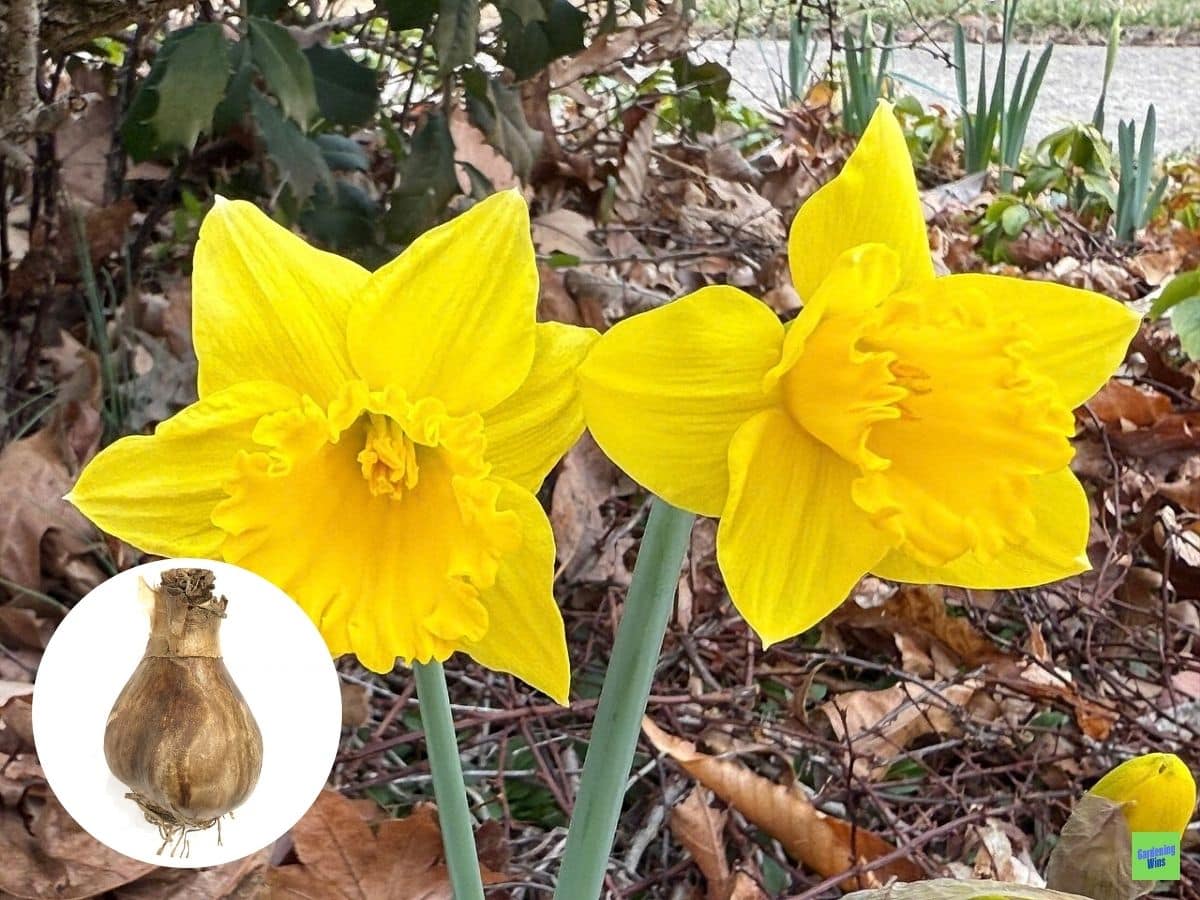
Few flowers announce spring as plainly as a big yellow daffodil. The central trumpet projects beyond the surrounding petals, giving each bloom the cheerful expression of something making a public announcement.
These are especially useful beside a frequently used path, where the flowers become part of your morning routine. Plant a group with enough room to mature instead of distributing single bulbs like punctuation across the entire yard.
The photographs show trumpet daffodils sold as King Alfred Improved. Match the name on your own bag when checking height and bloom timing; the daffodil family contains far more variety than one familiar yellow flower suggests.

For large trumpet daffodils, a useful planting guide is 6–8 inches from the bulb’s base to the soil surface, with similar spacing. Choose sun or light shade and soil that drains freely.
The aftercare takes patience: let the leaves yellow naturally after flowering. Folding them into decorative knots only makes their job harder. Put later-emerging companions nearby to soften the view while those leaves replenish the bulb for another season.
2. Lady tulips: a little flower with a costume change

Lady tulips, Tulipa clusiana, bring a lighter, more delicate look than the chunky tulips in supermarket bouquets. Their pointed petals can show pink on the outside and pale interiors, opening into stars when conditions suit them.
That change is part of the attraction. A planting can look quite different as the flowers open, especially when you see it at different times of day. Give these smaller tulips a spot near the front of a bed, where the details won’t disappear behind taller plants.
Cultivars and forms vary in color, so shop by the full label rather than expecting every lady tulip to match one photograph.

Sun and a dry summer resting period are the useful clues. Plant in fall in freely draining soil, and avoid a spot that receives heavy irrigation all summer after the leaves disappear.
Species tulips can be rewarding repeat performers in suitable conditions, including some Southern gardens where big bedding tulips disappoint. That is an advantage worth exploring locally, rather than a promise that every bulb will return forever.
3. Spring crocus: put the first color at shoe level

A crocus makes you look down at exactly the time of year you’ve nearly given up looking for flowers. Crocus vernus produces low cups in white and shades of purple, above narrow leaves that can seem almost grassy.
Plant a generous little patch near steps or along the edge of a bed. From across a large lawn, a handful can vanish; beside a path, even a modest group has a chance to be noticed.
The small underground package is a corm, not a layered true bulb. It belongs in a sunny, well-drained location, planted in fall. Plant about 3–4 inches deep to the base.

Crocuses can also grow through grass, but that comes with a practical condition: the foliage needs to finish its work before mowing. Choose somewhere you can leave alone while the leaves remain green.
Squirrels and other animals may find the planting interesting, too. If bulbs repeatedly disappear, physical protection is worth considering. A lovely catalog picture won’t deter a determined garden visitor.
4. Garden hyacinths: plant the perfume where you’ll pass it

Hyacinths deserve a location chosen with your nose as well as your eyes. Hyacinthus orientalis packs many small flowers onto a stout spring spike, creating a concentrated patch of color and fragrance.
A few near a walk or seating area make more sense than hiding them at the far end of the property. Blue, purple, pink, and white varieties offer plenty of ways to fit an existing border without turning it into a paint-sample display.
The substantial bulb in the inset helps explain why a relatively compact plant can produce such an extravagant flower spike. Choose firm bulbs and wear gloves when handling them; hyacinth bulbs can irritate skin.

Give them sun or partial shade and well-drained soil. Use 6 inches to the bulb’s base as a planting depth, with 6–8 inches between bulbs.
Later displays may be looser than the densely packed first-year spikes. That softer appearance can still be lovely in a mixed garden. Let the foliage mature after flowering, and don’t keep dormant bulbs sitting in wet soil through summer.
5. Grape hyacinths: a small blue crowd beats one lonely stem

Grape hyacinths look as though someone carefully assembled tiny blue beads into miniature towers. Muscari armeniacum is short enough for the front of a border, but a group delivers color well beyond its individual size.
The flowers and grassy leaves work beautifully beside larger spring bulbs. Use them as a repeating patch rather than expecting a single plant to carry an entire corner of the garden.
Despite the common name, this is a different genus from the big, perfumed garden hyacinth. The compact bulb produces a very different style of spring display.

Plant in fall in sun or partial shade, with good drainage. A useful starting point is 3–4 inches deep to the base and 3–4 inches apart.
Don’t panic if fresh leaves appear in autumn: that is normal for this plant. It can also spread by offsets and seed, which is delightful where you want a blue patch to expand and less delightful among tiny treasures. Give it a defined area, then divide or thin it when necessary.
6. Drumstick alliums: let fall’s planting carry into summer

Not every ornamental onion makes a giant purple globe. Allium sphaerocephalon produces smaller, egg-shaped flowerheads on slender stems, bringing a completely different rhythm to a border.
The heads begin green and develop reddish-purple color as the little flowers open. That gradual change gives you something to watch before the display reaches its fullest color.
With stems commonly around 30–40 inches tall, drumstick alliums can rise through neighboring perennials without hiding them behind a solid wall of leaves. They are particularly useful when you want dots of color suspended above lower growth.

Plant the bulbs in fall. Allow 4–5 inches deep and 2–3 inches apart, with well-drained soil and a sunny position. Moisture matters during active growth, even though established plants tolerate summer drought.
Flowering comes in late spring or early summer, extending the reward from your autumn work. The plants can spread by seed and offsets, so watch their boundaries. Enjoy the onion-family connection as botanical trivia; keep these ornamental bulbs out of the kitchen basket.
7. Snowdrops: the flowers you go outside to check on

Snowdrops are wonderfully good at making a gardener inspect the same small patch of ground several days in a row. Galanthus nivalis hangs white flowers close to the earth in late winter or early spring.
Look closely and the construction is distinctive: three long outer petals surround shorter inner segments with green markings. The flowers are modest in size, but arriving so early gives them an audience with very little competition.
A place beneath deciduous shrubs or trees can suit them well, especially where you pass close enough to appreciate the details. The canopy’s seasonal changes are part of the setting.

Choose humus-rich soil that holds some moisture without becoming stagnant. Plant fresh, healthy bulbs promptly in fall, around 3–4 inches to the base, and avoid leaving them forgotten until they become dry, lightweight shells.
This is a patient planting: a settled clump is more satisfying than repeatedly moving individual bulbs around. When division is needed, established snowdrops can be split after flowering while still in leaf. Keep them labeled; the bulbs are ornamental and must never be mistaken for food.
8. Balkan windflowers: a spring carpet with daisy faces

Balkan windflowers, Anemone blanda, have an appealingly informal look. Their blue, pink, or white flowers sit above finely divided leaves, giving a planting the feel of little daisies that arrived before everyone else.
They stay low, so use them near an edge, between larger spring plants, or beneath deciduous shrubs. The point is to see a patch of flowers instead of making each individual one compete with a large perennial.
The planting pieces can surprise first-time buyers. These are irregular tuberous underground stems, not neat onion-shaped bulbs with an obvious papery jacket. Keep the labeled packet nearby until planting is finished.

Bright spring light and good drainage are the priorities. Partial shade suits them; a sunnier location needs adequate moisture during growth. Plant in fall according to the supplier’s directions for the stock you receive.
After flowering, the plants head toward summer dormancy. Leave the foliage alone while it is green, and mark the location so you don’t excavate the resting tubers while filling summer gaps. Avoid continually soggy soil, which can rot the underground parts before next spring’s little carpet has a chance.
9. Crown imperials: for the border that needs a bit of theater

Crown imperial, Fritillaria imperialis, is what happens when a spring bulb decides subtlety is overrated. A tall stem carries a ring of hanging bells beneath a tuft of green leaves, like a flower wearing an extravagant hat.
Orange-red and yellow forms make strong accents among lower spring flowers. The pictured flowering plants are ‘Rubra Maxima’, whose warm red-orange bells look especially rich against fresh green foliage.
These can grow roughly 3–4 feet tall, so give them room to stand above their neighbors. Put them somewhere you can admire the whole stem, not just a crown disappearing behind a shrub.

The large bulbs have a conspicuous hollow where the old stem grew. Try planting them on their side to keep water from collecting there, about 6 inches deep to the base.
Drainage is essential, and the bulbs are best left undisturbed once established. One more shopping note: the plant has a strong odor. That is a reason to choose its position thoughtfully, not a guarantee that it will repel every hungry animal in the neighborhood.
10. White Beauty fawn lilies: save a good spot under the trees

‘White Beauty’ fawn lily is a choice for gardeners who enjoy flowers that reward a closer look. Erythronium ‘White Beauty’ carries creamy nodding blooms with swept-back petals and darker markings toward the throat.
The broad, lightly mottled leaves are part of the appeal, too. This is a small woodland-style plant, roughly a foot tall, so put it somewhere its leaves and flowers won’t be swallowed by larger neighbors.
Its elongated bulb looks very different from a daffodil bulb. That unusual shape is a useful reminder to keep the label with the planting stock until everything is in the ground.

Don’t let these bulbs dry out in storage. Buy from a supplier that handles them carefully, prepare the planting area first, and plant promptly when they arrive in fall.
Choose partial shade and fertile, humus-rich soil that retains moisture while draining well. The RHS recommends planting around 4 inches deep. This is a better choice for a cool, sheltered woodland pocket than a baked strip beside pavement. After the flowers fade, give the leaves time to finish before tidying the area or disturbing the bulbs.
11. Winter aconites: yellow before the garden looks awake

Winter aconites are tiny, bright, and remarkably difficult to ignore when the rest of the garden is mostly brown. Eranthis hyemalis produces yellow cups surrounded by a green, frilly collar of leaves.
That collar makes each flower look dressed for the occasion. A little colony beneath deciduous trees can be especially effective, taking advantage of the light before the branches fill with leaves.
The underground parts are small, knobbly tuberous stems. They don’t resemble the familiar pointed bulbs that make planting orientation feel obvious. Buy healthy stock from a reputable supplier and follow its handling instructions.

Plant in late summer or early fall, around 2–3 inches deep and 3 inches apart, in soil enriched with organic matter. Moisture during growth matters, but drainage still needs to be good.
This is a cool-season choice that dislikes excessive heat. Place it where its late-winter or early-spring performance fits your climate, rather than expecting it to behave the same in every region. All parts are poisonous if eaten, so keep the tubers securely labeled and away from children or pets that might dig or sample them.
12. Coral lilies: small orange lanterns for the next act

Coral lily, Lilium pumilum, gives your fall planting a later payoff. Its small orange-red flowers face downward, with petals curling back to expose the center, bringing a lively shape to the border.
The plant is relatively compact for a true lily, often around 2 feet tall. Narrow leaves and slender stems keep it from looking bulky among neighboring perennials.
Unlike a tulip’s papery-coated bulb, a lily bulb has fleshy scales. Handle it gently and plant promptly after purchase. Leaving it out to dry while you decide where it belongs is an avoidable setback.

Choose a sheltered position with sun on the upper growth and neighboring plants shading the base. Moist, well-drained soil is the goal, not a dry gravel pocket or a permanently wet hole.
For these smaller bulbs, use the supplier’s size-specific depth instructions; the RHS’s lily-growing guide gives about 3 inches for small L. pumilum bulbs. Summer flowering extends the season beyond the early spring rush. Choose another plant where cats have access; all parts of true lilies, including pollen, are dangerous to them.
13. Turk’s-cap lilies: a taller native choice for moist ground

Turk’s-cap lily, Lilium superbum, takes the summer portion of a bulb garden upward. Stems can reach 4–8 feet, carrying orange flowers with dark spotting and dramatically curved-back petals.
The leaves form whorls around the stems, making the plant interesting before the flowers fully open. Give it enough space to show its natural shape, toward the back of a border or in a suitable naturalistic planting.
This species is native to the eastern and central United States. Buy nursery-propagated bulbs rather than digging plants from the wild; the label should give the botanical name so you know which “Turk’s-cap” you are getting.

Fall is a suitable time to plant healthy lily bulbs. Allow 5–6 inches of depth for this species, in humus-rich soil that remains moist and drains well, with sun or partial shade.
A dry, exposed site is a poor match. Mulch can help retain soil moisture, and tall stems may need support in windy positions. Deer and voles can damage them, and, as with coral lilies, keep them out of areas accessible to cats.
14. Spring fumewort: a different shape for the woodland corner

Spring fumewort, Corydalis solida, deserves a look if your bulb shopping always begins and ends with the same three bags. Its clusters of narrow, spurred flowers rise above divided gray-green leaves, creating a soft, intricate spring display.
Pink, purple, and white forms are available. The flower shape is the surprise: look closely and each little bloom has a projecting spur, quite unlike a tulip cup or daffodil trumpet.
At roughly 10 inches tall, this is a plant for a position where you can appreciate smaller details. A lightly shaded border beneath deciduous shrubs can offer an inviting setting, provided the soil drains well.

The inset shows the rounded tuber that supports all that delicate top growth. Plant healthy tubers in early autumn, following the supplier’s depth guidance, and keep the name attached to the planting spot.
Moderately fertile soil and good drainage are more useful than lavish feeding. When choosing companions, allow the small spring growth some breathing room rather than surrounding it with plants that quickly smother the space. This is a satisfying addition for someone who already loves the familiar bulbs and wants a new detail to discover.
15. Ivy-leaved cyclamen: the fall-flowering exception

Here is the deliberate exception to all that waiting for spring. Cyclamen hederifolium flowers in early fall, with swept-back pink or white petals that look almost airborne above the soil.
Its patterned, ivy-shaped foliage extends the interest through the cooler months. Under suitable deciduous trees or shrubs, the leaves can be as attractive as the flowers, filling a small space when many summer plants are winding down.
The flattened tuber is unmistakably different from a pointed tulip bulb. Buy nursery-grown stock; plants already rooting are easier to orient correctly and establish than neglected, dried-out tubers.

Choose partial shade and humus-rich, well-drained soil, and avoid excessive moisture during summer dormancy. This is a shallow planting: the RHS gives roughly 1¼–2 inches, so don’t bury it in the deep hole you prepared for daffodils.
Check local winter suitability before buying, especially in very cold regions. Fall planting is appropriate when conditions allow establishment, but it does not guarantee immediate flowers from every dormant tuber. A healthy potted plant is a useful option when you want to see exactly what you’re bringing home.
Before you reach for the trowel
This is a menu, not a shopping list for every climate. Many spring bulbs need winter cold; a warm, frost-free garden needs locally adapted selections or a specific chilling plan. Check your local extension recommendations and the named variety’s hardiness before ordering.
Plant while the soil is workable, allowing time for roots to develop before it freezes. That calendar varies enormously across the country. Buy firm, healthy stock, and prepare the planting spot before opening the bags.
“Bulbs” is the convenient garden-center umbrella here. Crocuses have corms; windflowers and winter aconites have tuberous underground stems. The right plant in the right soil matters more than giving everything the same planting hole. Some inset photos show growing specimens with roots or shoots, rather than the dry stock you’ll find in a bag.
Give next year’s flowers a fair start
Before you plant, photograph the bed and mark the positions. Those little labels are much easier to read than your memory when the plants disappear for summer.
Water after planting to settle the soil, then respond to actual moisture conditions instead of following an automatic daily schedule. Most of these plants need drainage; a bulb is not improved by sitting in a puddle.
Let green leaves do their work after flowering. Remove them once they have yellowed naturally. Base fertilizer decisions on your soil and the plant’s needs rather than adding bone meal to every hole by habit.
Keep ornamental bulbs separate from food, and store them where children and pets cannot reach them. Then choose a few compatible plants, give them a place where you will actually see the flowers, and get them planted. The best bulb collection is the one that makes it out of the shopping bag.
Sources and planting notes
Planting guidance draws on Iowa State Extension’s bulb guide, University of Minnesota Extension, and the RHS bulb-planting guide. Depths are starting points; bulb size, soil, climate, and supplier instructions can change the appropriate choice. Check local guidance before ordering.
Plant profiles: Trumpet daffodils, Lady tulips, Spring crocus, Garden hyacinths, Grape hyacinths.
Plant profiles: Drumstick alliums, Snowdrops, Balkan windflowers, Crown imperials, White Beauty fawn lilies.
Plant profiles: Winter aconites, Coral lilies, Turks-cap lilies, Spring fumewort, Ivy-leaved cyclamen.
Additional guidance: lily planting depths, cyclamen planting, snowdrop division, Corydalis autumn planting, and warm-winter bulb limitations. The cat warning follows Virginia Tech’s veterinary guidance on lilies.
Photo credits
All photographs are real images sourced through Wikimedia Commons. Images were cropped and composed in Canva; the first photograph in each numbered section includes a circular inset of the same plant’s underground storage organ. Gardening Wins branding was added. Photo adaptations are available under CC BY-SA 4.0; original source licenses are credited below. Brand marks remain the property of their owner.
1. Trumpet daffodils. First photo: 2025-03-16 16 19 47 King Alfred Trumpet Narcissus Improved Daffodil flowers along Aquetong Lane in the Mountainview section of Ewing Township, Mercer County, New Jersey.jpg — Famartin, CC BY-SA 4.0; Inset: 2022-11-11 08 46 35 A King Alfred Trumpet Daffodil Narcissus Improved bulb ready for planting in the Mountainview section of Ewing Township, Mercer County, New Jersey.jpg — Famartin, CC BY-SA 4.0; Second photo: 2023-04-05 13 11 43 A row of King Alfred Trumpet Narcissus Improved Daffodils blooming along Aquetong Lane in the Mountainview section of Ewing Township, Mercer County, New Jersey.jpg — Famartin, CC BY-SA 4.0.


2. Lady tulips. First photo: Tulip Tulipa clusiana ‘Lady Jane’ Rock Ledge Flower 2000px.jpg — Photo by and (c)2007 Derek Ramsey (Ram-Man). Location credit to the Chanticleer Garden., CC BY-SA 3.0; Inset: Tulipa clusiana Zwiebel.tif — Hellebore3, CC BY-SA 3.0; Second photo: Liliaceae Tulipa clusiana 1.jpg — NasserHalaweh, CC BY-SA 4.0.


3. Spring crocus. First photo: Saffron Crocus vernus cultivar two flowers.jpg — Dixi from Polish Wikipedia, CC BY-SA 3.0; Inset: Saffron – Crocus vernus 47.jpg — Obsuser, CC BY-SA 4.0; Second photo: Crocus vernus.jpg — Smihael, CC BY-SA 3.0.


4. Garden hyacinths. First photo: Hyacinthus orientalis ‘Aqua’ Hiacynt wschodni 2023-04-16 03.jpg — Agnieszka Kwiecień, Nova, CC BY-SA 4.0; Inset: Treibende Hyazinthen.JPG — 4028mdk09, CC BY-SA 3.0; Second photo: Hyacinthus orientalis ‘Aqua’ Hiacynt wschodni 2023-04-16 01.jpg — Agnieszka Kwiecień, Nova, CC BY-SA 4.0.


5. Grape hyacinths. First photo: Muscari armeniacum2.jpg — Fizykaa, CC BY-SA 3.0; Inset: Muscari armeniacum sl11.jpg — Stefan.lefnaer, CC BY-SA 4.0; Second photo: Flor de nazarenos (muscari armeniacum).jpg — Bea.miau, CC0.


.jpg)
6. Drumstick alliums. First photo: Alcalá de Henares (RPS 01-06-2024) Allium sphaerocephalon.png — Raimundo Pastor, CC BY-SA 4.0; Inset: Allium sphaerocephalon bulb.jpg — Pablo Alberto Salguero Quiles, CC BY-SA 3.0; Second photo: Allium sphaerocephalon, Beechview, 2022-07-03, 03.jpg — Cbaile19, CC0.
_Allium_sphaerocephalon.png)


7. Snowdrops. First photo: Galanthus nivalis Aarau 1.jpg — Daniel Ballmer, CC BY-SA 4.0; Inset: Galanthus nivalis sl10.jpg — Stefan.lefnaer, CC BY-SA 4.0; Second photo: 2015 Galanthus nivalis and Primula vulgaris.jpg — Kreuzschnabel, CC BY-SA 3.0.


8. Balkan windflowers. First photo: Anemone blanda – Winter windflower 01.jpg — Zeynel Cebeci, CC BY-SA 4.0; Inset: Anemone blanda sl7.jpg — Stefan.lefnaer, CC BY-SA 4.0; Second photo: Blauwe anemoon (Anemone blanda).JPG — Dominicus Johannes Bergsma, CC BY-SA 3.0.


.JPG)
9. Crown imperials. First photo: Crown Imperial Fritillaria imperialis Rubra Maxima Newark Park Ozleworth Gloucestershire England 01.jpg — Acabashi, CC BY-SA 4.0; Inset: Fritillaria-imperialis bulbe.jpg — The County Clerk, CC BY-SA 2.0; Second photo: ‘Fritillaria imperialis’ Rubra Maxima at Feeringbury Manor, Feering Essex England.jpg — Acabashi, CC BY-SA 4.0.


10. White Beauty fawn lilies. First photo: Erythronium ‘White Beauty’.jpg — Francine Riez, CC BY-SA 3.0; Inset: Erythronium White Beauty bulbs.jpg — Шатилло Г.В., CC BY-SA 4.0; Second photo: Erythronium ‘White Beauty’ clump.jpg — Meneerke bloem, CC BY-SA 3.0.


11. Winter aconites. First photo: Eranthis-hyemalis-winterling.jpg — Holger Krisp, CC BY 3.0; Inset: Eranthis hyemalis sl4.jpg — Stefan.lefnaer, CC BY-SA 4.0; Second photo: Winterakoniet (Eranthis hyemalis) Locatie, Tuinreservaat Jonkervallei 02.jpg — Dominicus Johannes Bergsma, CC BY-SA 4.0.


_Locatie,_Tuinreservaat_Jonkervallei_02.jpg)
12. Coral lilies. First photo: Lilium pumilum 1b.JPG — Ghislain118 http://www.fleurs-des-montagnes.net, CC BY-SA 3.0; Inset: Liliumpumilumbulbs.jpg — Mag. Dr. Markus Hohenegger, CC BY-SA 3.0; Second photo: Lilium pumilum (Ogoy Island) 3.jpg — Lumaca, CC BY-SA 4.0.


_3.jpg)
13. Turk’s-cap lilies. First photo: LiliumSuperbum1.jpg — Original uploader was Arx Fortis at en.wikipedia, CC BY-SA 3.0; Inset: Liliumsuperbumbulbs.jpg — Mag. Dr. Markus Hohenegger, CC BY-SA 3.0; Second photo: Lilium-superbum-waterrock-knob-2.jpg — JustSomeGuy4361, CC0.


14. Spring fumewort. First photo: Corydalis solida kz05.jpg — Krzysztof Ziarnek, Kenraiz, CC BY-SA 4.0; Inset: Corydalis solida with tuber.jpg — Jaak Kikas, CC BY-SA 4.0; Second photo: Corydalis solida 2 RF.jpg — Robert Flogaus-Faust, CC BY 4.0.


15. Ivy-leaved cyclamen. First photo: Cyclamen hederifolium. Locatie, Tuinreservaat Jonker vallei 02.jpg — Dominicus Johannes Bergsma, CC BY-SA 4.0; Inset: Remscheid Lüttringhausen – Bauernmarkt 04 ies.jpg — Frank Vincentz, CC BY-SA 3.0; Second photo: Cyclamen hederifolium kz02.jpg — Krzysztof Ziarnek, Kenraiz, CC BY-SA 4.0.


